

If you look at almost any local youth sports organization today, you’ll notice a common organizational structure: kids are grouped primarily by age, often called “age-based sports.” In this structure, 9-year-olds play in a 9U division, 11-year-olds in 11U, and so on. While some organizations use two- or three-year age bands, many have adopted increasingly narrow age classifications.
This is understandable. Age is easy to administer and appears to create a level playing field.
But it brings up an important question: Are we pursuing competitive fairness at the expense of athlete development?
These two goals may not always align.
Personal Reflection
I started reflecting on this more deeply shortly after I took a position on the phenomenon of relative age in a previous blog post.
While I will still argue against a child always being the youngest in his group, that’s a very different position than saying that being the youngest has no value. Being among the youngest does have value. And there is value in being among the oldest. But the real value is in taking turns.
Looking back on my experience growing up in youth baseball, there were only three age divisions between ages 7 and 15. It was similar with basketball and soccer. In baseball, specifically, the age divisions for our local league were:
- 7-9 years old: C League
- 10-12: B League
- 13-15: A League
I can support the strong argument for allowing younger athletes to compete with and against slightly older, more developed athletes.
The Youngest Athlete May Gain More, Not Less
In his book Free to Learn, psychologist Peter Gray writes, “The free mingling of children who differ broadly in age is a key element to children’s abilities to educate themselves successfully, on their own initiatives. … From a historical perspective, and certainly from an evolutionary perspective, the segregation of children by age is an oddity … of modern times.”
While Gray’s work focuses primarily on age-mixed play rather than organized sports, the underlying principle is relevant. His argument suggests that an 11-year-old who plays among the biggest, fastest, or most experienced players may struggle to address problems beyond their current capabilities. However, when placed alongside 12- or 13-year-olds, the dynamic changes. They may need to think more quickly, make faster decisions, improve their techniques, and become more resourceful.
Developmental psychologist Lev Vygotsky identified this as the Zone of Proximal Development, which is the space between what a learner can achieve independently and what they can accomplish with the guidance of someone more skilled.
Older Kids Teach More Than Skills
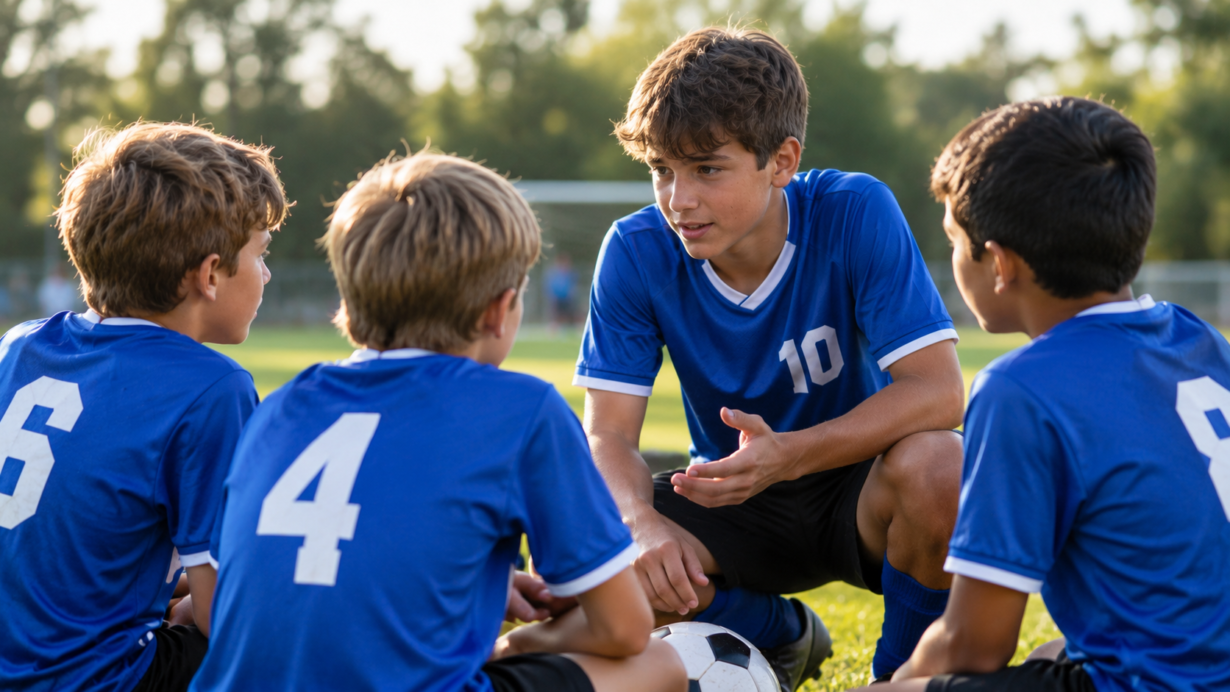
Coaches teach athletes what to do, while older athletes can demonstrate what being an athlete looks like.
An older teammate serves a unique role: they are relatable yet advanced enough to represent what is possible.
A younger player observes how an older teammate reacts to a bad call, handles a loss, encourages a teammate, communicates with a coach, and accepts responsibility for mistakes.
For example, a coach telling a 10-year-old to be a good sport represents instruction, while watching a 12-year-old they admire shake hands with an opponent after a tough loss serves as a powerful example.
A 2021 study published in the Journal of Sport for Development by L.M. Lower-Hoppe, D. Anderson-Butcher, T.J. Newman and J. Logan examined how peers influence life-skill development and transfer in sport-based youth programs. Their research involved 483 young people ages 8-15 in a sports-based positive youth development program to examine life-skill development and transfer, and how peer characteristics predicted post-program life-skill scores They concluded that peers significantly influence youth development.
The Benefits are Mutual
When older athletes take on the role of role models, they experience growth in different ways. Teaching, mentoring and leading requires each athlete to develop a deeper understanding of their own skills.
Research published in Medical Teacher in 2016 by E.L. Rees, P.J. Quinn, B. Davies and V. Fotheringham found that peer teaching can benefit both the student doing the teaching and the student being taught, with outcomes comparable to those of professional educators.
Youth sports can offer similar opportunities. For instance, a 12-year-old who explains a defensive rotation to a 10-year-old may gain a deeper understanding of that concept. Teaching can be a powerful way to deepen one’s own understanding, and youth sports can provide kids with opportunities to grow by taking on roles as teachers, mentors, and leaders.
Sometimes, the best way to become a leader is to realize that someone is looking to you for guidance.
Developmental Cycle
This isn’t an argument against age-based divisions in youth sports. Age divisions serve an important purpose, particularly when differences in size, physical maturity or skill create legitimate safety concerns.
The question isn’t whether age matters. It does. The question is whether chronological age should always be the primary organizing principle when developmental benefits might come from allowing athletes to interact across a broader age range.
The benefit of a multi-age environment shows up over time.
- At 10, you’re the youngest (learner)
- At 11, you’re somewhere in the middle (peer)
- At 12, you’re the older athlete (mentor)
In this cycle, a kid is learner, peer, and mentor.
The athlete remembers what it felt like to be the youngest player trying to keep up. Later, that same athlete becomes the person encouraging his younger teammates.
For a kid who plays youth sports from age 7 through 15, the cycle reinforces itself over a nine-year youth sports career.
This speaks to the developmental value of having a range of ages within those divisions. If we optimize youth sports in this manner, it should prepare kids to become better athletes—and better teammates, leaders and people.