

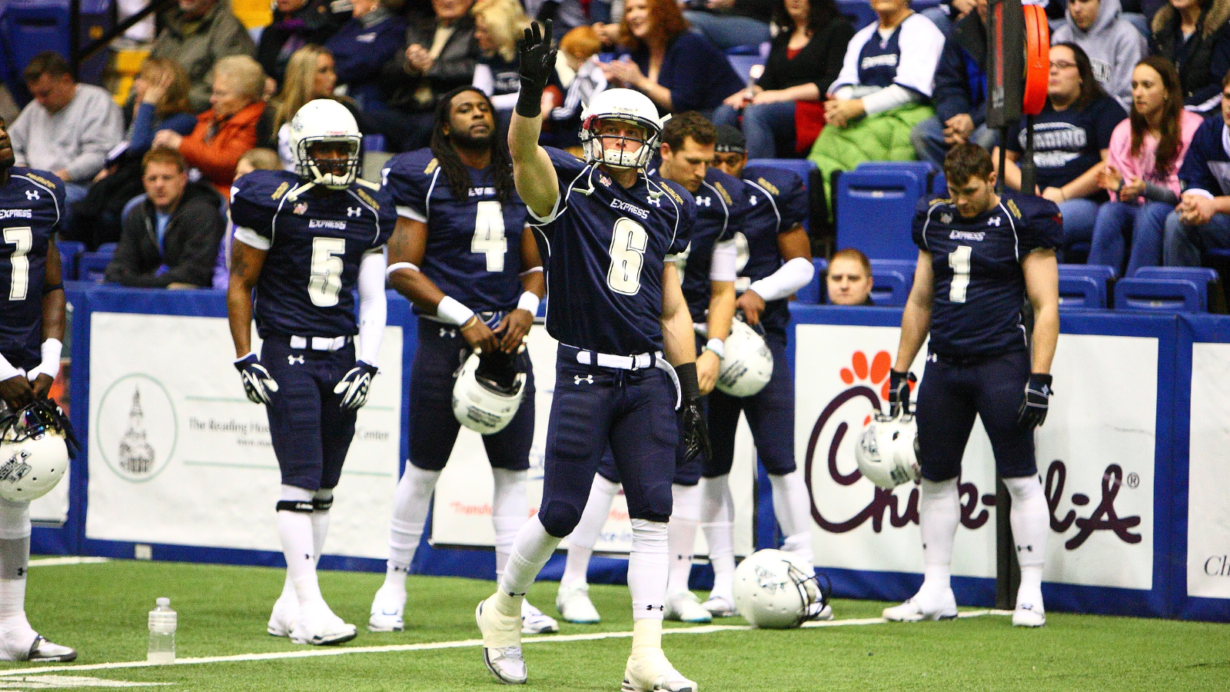

In 2010 I was approached about taking the general manager role of an indoor professional football franchise in Reading, Pa. The Reading Express, one of the most successful teams in the sport, had been in an attendance slump. The organization was seeking a new vision and a fresh approach as it moved up to the then nationwide, 22-team Indoor Football League. I found the challenge attractive, accepted without much hesitation, and set out break the trend of a mult-year attendance decline.
The franchise rode a sellout crowd for its home opener in 2008 to a decent average attendance at the end of the season. But 2009 and 2010 saw consecutive dips. In the 2009, the slide in average attendance was 16%. It fell another 11% by the end of the 2010 season. Note: These figures are based on the drop count, as reported by the arena.
The product on the field wasn’t the issue. This was a franchise that won 73 of its first 100 games. In 2009, the team won the championship in the American Indoor Football Association. The Express had become unarguably one of the best teams in the indoor game. The team had always been led by a GM with a strength in football operations. However, those wins alone were not enough to grow the fan base. In the effort to move the needle on attendance, the organization decided to turn to a GM with a strong marketing and communications acumen for the 2011 season.
This was an exciting opportunity for me. I was able to step in immediately and provide that fresh approach the organization was looking for. We re-tooled several facets of our marketing and communications, made improvements in the game day piece, and expanded community relations. In the end, we were able to stem the tide of a multi-year attendance decline and finished the 2011 season up 20% over the previous year. To boot, our success was key in helping Reading, Pa., be named at No. 4 in Street & Smith’s Sports Group’s biennial ranking of the top U.S. minor league sports markets, the city’s highest ranking ever. We were recognized by our league peers as well in receiving the IFL’s Community Relations Award in 2011.
Our success was driven by an ownership that was easily one of the best in the sport, a staff and supporting cast that were committed, corporate partners that were engaged and a fan based that bled Express blue. This story is a broad stroke across the surface of the fresh approach to breaking that attendance slump.
SETTING THE STAGE
The Reading Express shared a home arena with an ECHL hockey team. Both organizations had the task of selling the same number of seats per game, and for many of those were on par with each other. That’s where the similarities ended.
In minor league hockey, as in minor league baseball, there seems to be a prevailing operations and personnel model that permeates through teams in the mid markets. The full-time staff and personnel is deep enough for individuals to work exclusively in areas such as group ticket sales, individual ticket sales and corporate partnership development.
In the Indoor Football League, however, there is no prevailing model. That’s not to say no individual team can have a good model. The point is that the Express had a model that may be unique in minor-league level sports in mid markets. The Express had just three full-time staff members. It was a good mix, though. We had a GM that was strong in marketing and communications, a head coach who had good business acumen and really embraced his strength in the sales process, and an operations director that could move into any area of the business and make a positive impact.
In August 2010, just a week after I joined the company, I brought the small staff together for a “mini-camp” of sorts, and included the ownership and a supporting cast from the parent company in the process. It was a time to assess the status quo and lay out all the improvements and new strategies to implement for the upcoming season. These conversations drove home some areas that the team could improve on.
- Communications: We needed to establish a year-round narrative. One of the challenges with this sport is that it is a fairly short five-month regular-season. In this piece, especially, we could create a sense that the we were already in the midst of the 2011 season, even though the first game wouldn’t be played for another six months.
- Community Relations: We determined to expand an already strong presence with community events to include new programs for youth.
- Marketing: The essence of past marketing programs, campaigns and creatives would need to be revamped, with a new approach taking a cue from the sports industry at large.
- Game Nights: With the challenge of having a small staff with no one dedicated exclusively to ticket sales, we would need to be intentional in seeking partnerships that would provide strategic opportunities to directly reach their audience with our product.
The corporate partnership piece also added a sense of urgency in our effort to increase attendance. A couple of years earlier, the organization secured several three-year partnership agreements that sold a healthy average attendance figure. The team had reached that attendance number for individual games, so the promise and potential was understood. However, after two years under those partnership agreements, the average attendance figure had slid far away from the number that was sold. The 2011 season would be crucial to the renewal conversations.
And, of course, we wanted to win football games.
COMMUNICATIONS
Once we decided to acknowledge August 2010 as the start of the 2011 season, a communications strategy started to take shape. This was an area in which the team could show marked improvement immediately. At this point in the year, though, scoring articles in the major daily or features on the evening news was a larger task. So that put a big focus on our own channels, including the team’s official Web site and social media networks.
The official Web site was revamped, but not with a complete overhaul. The organization had launched a new site a year before in a deal with a leading national sports-specific Web design group. We cleaned up some of the excess, repositioned some of the graphic placements and got rid of pages that were either empty or unnecessary. These changes also helped create a more aesthetically pleasing look across a desktop, laptop or smartphone. Then we went to work on content.
We got a push into the new season with a public press conference in August to announce the team’s move up to the Indoor Football League and introduce a new GM. This news did lands us in the daily newspaper and on the local television news show. It was also a good sailing off point for our new communications strategy. The press conference was followed by IFL league meetings in Chicago two weeks later, so we certainly didn’t lack content right out of the gate.
One of the more significant changes we made was in the way the team announced player signings. Players are typically signed one at a time beginning in the fall before the upcoming season. In the past, many players had been announced in groups. For the 2011 season, we announced them one at a time, and often scheduled their signing announcements to fit our communications strategy.
With individual announcements came greater detail on each of the players. We even sought quality images from their collegiate sports information departments or previous pro teams. In doing this, we were able to push out better content on a weekly basis. As a result, the Express now made the newspaper on an almost weekly basis and our own channels were regularly updated with fresh content. More importantly, though, our fans became increasingly excited about the new season.
In addition to player news, we regularly ran features and profile around team-related news and events, such as football operations, Steam Team recruitment, community event involvement and various league matters.
While there was a noticeable uptick in media coverage in the daily paper and on the local television news program, we were also enjoying a spike in traffic to our Web site and rising numbers on our social networks, particularly on Facebook. However, the first real sign that our fans were energized for the season came at the team’s annual introduction event.
We re-branded the 2011 event to be called a Launch Party and added a little more entertainment with our youth dance troupe. The party, held at center stage at the local mall, was crowded as we formally introduced the team and its ambassadors just seven days before the home opener. While attendance figures were never kept for this public event, several eyeball accounts put the 2011 Launch Party as the most successful one of them all.
Once the season started opportunities to push out content, press releases and story pitches began to pile up. We continued to implement best practices in sports PR and ran weekly pre-game reports days before the event, game day notes on the morning of and post-game reviews within an hour after the event. Special content such as Player of the Week was always slated for the Monday after the game. In effect, we generated content at least four times a week during the season. Any special features, profiles or announcements just added to the pile.
In addition, we wanted to make sure our fans attending the game had better access to more information on the team and its players. So we opted to offer the Game Day program free of charge. It was previously only offered for sale. It was evident the move was well-received by the number of programs that were signed during the post-game autograph session with players on the field.
COMMUNITY RELATIONS
The organization had long been active in community affairs, making appearances at festivals, parades, non-profit fundraisers and other special events. This had always been one of the primary objectives of the ownership. The team would regularly feature various players and ambassadors at these events, and send its mascot and signature train to complement the show. The train was the big hit. Built on the chassis of an old 1994 Chevrolet Blazer, the train, along with its loveable engineer Papu, was a staple at events throughout the market.
While community relations was strong, the ownership wanted to expand this effort for 2011. To that end, there was a makeover of one existing program and the introduction of three new programs.
While dance teams are common for teams in many professional sports, the dance portion was largely a by-product of the Express dance team’s main objective. The ownership wanted a dance team that was more engaging in the community than entertaining at the games. Not that such teams can’t be both engaging and entertaining. For the Express, it was just a matter of strengthening the primary objective. As a result, we totally revamped our Smokin’ Hot Steam Team from a dance group to an ambassador team to shift that focus from in-game entertainment to community appearances. The Steam Team kept its usual sporty outfit, and we added professional business attire to the wardrobe for more flexibility with events. Their new presence and look was well-received in the market. With the change came an Ambassador of the Year program that utilized a text campaign to assist with our overall marketing efforts. The text campaign provided the ambassadors with the opportunity to communicate our core product with discount savings on game tickets.
We didn’t completely abandon a dance troupe, though. We added a new youth hip hop program called Junior Junction in association with a former NBA cheerleader and local pro dance instructor. Junior Junction was open to boys and girls ages 6-16. The program featured two primary components: instructional clinics for all and a Junior Junction dance team comprised of the most-talented performers in the county. In addition to performing at Reading Express home games, the Junior Junction dance team also had the chance to participate at other team functions.
The 2011 season would also mark the beginning of a partnership between the Express and the YMCA on a venture to bring the indoor football experience to youth players with a full-contact, tackle league using indoor football rules. The new league, known as Junior Express Football, powered by the YMCA, ran throughout the Express’ spring season, with youth games being played in the arena on Express game days.
Both the Junior Junction and Junior Express programs provided these kids with a great experience. On game days, we saw them wearing our brand, engaged with our event and, most importantly, in the stands with family and friends.
In addition, we also approached key supporters and put together an advisory board that consisted of corporate partners, community leaders and fan representatives. This group of individuals made an immediate impact from that first monthly meeting in September 2010 and continued contributing ideas and efforts in our attempt to grow the fan base through the end of the 2011 season.
MARKETING
When it came to putting a plan together to drive ticket sales, we had to acknowledge two challenges. For one, a sales and marketing effort was going to skew more toward marketing. A second challenge stemmed from a less-than-ideal home slate of just three Saturday games, with two Friday games and two Sunday games filling out the schedule.
As mentioned previously, our small staff didn’t have the benefit of a typical ticket sales department that is found with minor league hockey or minor league baseball teams. We did have the capability to field incoming phone orders, but were challenged in reaching a significant volume of outgoing ticket sales calls.
In the Reading market, Saturdays are the money games. Attendance typically spikes for Saturday games. Also, that night is more attractive to corporate partners for an official game night presenting sponsorship.
These challenges helped put an onus on the marketing campaign. An effective mix of television spots, print ads, radio plugs, billboards and other promotional mediums was going to be essential to getting fans through the turnstiles.
One of the first things we did was identify key sources of continued learning for our staff. We subscribed to SportsBusiness Journal, studied the Minor League Baseball business blog, and started an office book club of sorts to build a team library. We included popular sports marketing books such as The Elusive Fan, Marketing Outrageously and Ice to Eskimos.
In taking a good long look at the industry at large, and assessing efforts that worked, didn’t work or just piqued our own interest, our marketing pieces started to take shape. We leaned heavily on themes and concepts that had been used effectively by other sports organizations.
Television: A series of new television spots were produced in two parts. The leads featured Express personalities including the ownership and some the more popular players. Each of their scripts ended with a direct call to action to attend a game. On the backend of the spots, we used an infomercial-style graphic layout. We did this for a couple of reasons. One, since we used footage from the previous season, we could better hide some empty seats and produce a better focal point on the football action. And two, it allowed us to best meet our existing contractual obligations to include team sponsors in the ad, while not detracting our promotion of the event. The end result were spots that stayed on point for the entire 30-seconds.
The organization had previously been promoted by long-form television buys on a local broadcast station. However, we ramped up the 30-minute Inside the Huddle interview show, and doubling the show’s season from seven episodes in previous years to 15 in 2011. With the most intricate knowledge of the team, I stepped in as the show’s producer and host. We also eliminated the call-in portion and instead took fan questions before the show via our social networks. That gave us an opportunity to use every available minute to talk about our product and host corporate partners as special guests.
Radio: Our new radio ads departed from the usual “about us” theme and featured a story script over the first 18 seconds of the ad. The ads stirred the listener’s imagination with series that included “Imagine…”, “Picture it…”, “Right now…”, and “Just think…” themes. It was an attempt to get the listener to visualize what happens around our team and at our games. We capped the ad with a final 12 seconds that got our sponsor plugs in and pitched the vitals on game date and buying tickets. Also included in our overall buy were 15-second spots and bumpers.
One piece we kept in place was our customary morning radio appearance during drive time before each home game. We had the benefit of being partnered with the leading radio station in the county, so this was an opportunity that didn’t get much new treatment in 2011. We featured a good mix of players, ambassadors, executives and other special guests through the season.
Print: Our print ads ran in a mix of publications that included the major daily and a few hyper local weeklies. With the help of a local design agency, a corporate partner, we had a good base of creative elements to bring the overall design of our print ads in house. This allowed us to more readily customize our message and placements from ad to ad and week to week.
We also benefited from a great relationship with our home arena by working with their marketing department to place Express game ads in the daily newspaper. Their multi-event, year-round buying power produced lower ad rates. So we shaved some of our costs by placing our ads through the arena.
In addition, we expanded our print ad placement to new local weeklies. When we took an opportunity to learn about our fans during the season, we found that new print ads running down the Rt. 422 corridor were effective in pointing people toward our game. That lesson would not have been possible without a relationship with a nearby university’s sport management program, which surveyed 300 fans over two different home games.
Additional: Billboards were strongly used to promote the season-opener, and then a steady presence of both static and digital was kept through the rest of the season. Meanwhile, the team did the usual poster schedules and pocket schedules, but upped the number and distribution.
Discounts: We did employ discounting tickets during the 2011 season. However, we were very intentional in how we distributed those discounts. In the vast majority of the cases, the discounts were extended through personal contact. As mentioned previously in the example of the Steam Team text campaign, most discounts were driven through the people we knew or met in the community. We tried to tie these discount offers to a personal invitation as much as we could. Another reason we leaned on discounts is because the take of concessions got an increase in 2011; that was an additional incentive to get fans through the gate. One thing we avoided, though, was having a final per ticket rate was that was less than the cheapest ticket in the pricing model.
GAME NIGHTS
The team had long sold presenting sponsorships to its Game Nights. There were well-established sponsored events such as Teacher Appreciation Night, Firefighter Night and Community Cares Night, as well as a game night sponsored by our biggest partner, the local hospital group. However, we did have an opportunity to pursue new Game Night presentations that could net a significant number of ticket sales as well.
We ended up starting off our season with a presenting sponsorship from the regional career and technical insitute. The school had considered a significant partnership with the team in the past, but this time we were able to get them on board for an exciting new game night presenting sponsorship.
The new High School Senior Night featured a half-time high school quarterback challenge, a major draw for local sports team participation. The technical school had leveraged there sponsorship to gain greater access into schools in general, and with high school football programs in general. When it came time for the game night, 16 area high school football quarterbacks were on hand to compete in the halftime competition, while many of their teammates, classmates and family members cheered on from the stands. The institute also hosted about 300 high school seniors and football coaches for a pre-game hospitality night.
Another example was the addition of a Faith & Family Night, featuring a post-game concert with an A-list contemporary Christian music group. Such theme nights have been successful for many other sports teams. We learned a lot from the one we hosted. It presented a great opportunity to put our product directly in front of a significant segment of the county population during the promotion of the game. We did see a bump in attendance for this game, as evident by a special ticket tracking system we put in place. A Faith & Family Night concept of this magnitude was new territory for the organization, and we were fortunate to grab some of its potential in year one. Meanwhile, one presenting sponsor, our parent company, took an already popular event, Firefighter Appreciation Night, and expanded promotional outreach to all first responders.
In terms of in-game entertainment for the fans at the arena, which was important to the game experience and retention in ticket sales, the team continued to produce great games from start to finish. We did add a premium season-long giveaway contest, in association with a travel agency partnership, that dangled a vacation package that included a cruise to Bermuda. A makeshift small island was on the field at halftime, with fans flying paper airplanes in an attempt to land on the island. Those that were successful were entered into a random drawing.
WINNING FOOTBALL
For many teams in the sport, the GM is substantially involved in football operations. That was true of the Express’ previous GM, who did a great job of building a winning tradition. However, I took a step out of football operations. The football side was driven by the team’s head coach and his coaching staff. They didn’t skip a beat and kept that winning tradition alive in the 2011 season. The competitive team they put together only added to the weight of our marketing and communications strategy.
Combined with the Express’ well established good reputation among players across the entire sport, the team’s move to a bigger league for the 2011 season opened up a lot more opportunity to add some strong talent to the team. The 2011 Express featured guys that came out of big schools including Florida State, West Virginia, Indiana, Northwestern and Appalachian State. The entire roster was a mixture of skilled Division I guys down to standouts from Division III, and this team came together and played some exciting football.
The Express opened with a thrilling home win against our rivals from the Lehigh Valley and went on to capture the division title and a berth in the league’s playoffs. The team easily beat Chicago in the first round, and then lost a close one in Green Bay to finish the season.
UNCERTAIN FUTURE
The team was a winner. Attendance was on the rise. Fans were as engaged as ever. And, by perhaps the most important metric, our standing as a pillar in our market, the team was engaged in the community. This was a testament to everyone involved, starting with an outstanding ownership and incredibly supportive parent company. Professionally, the 2011 season with the Reading Express will forever be one of the most-memorable experiences of my career.
By the end of the season, though, the organization had moved closer to a transition that had been discussed for months. A potential future sale of the team was even in the discussion during my initial interview a year earlier.
Considering the path we were on, one could easily argue that, from a business perspective, this was a prime time to transition to a new era. On June 1, just a few days before the final regular-season home game of the 2011 season, the ownership announced the team was for sale. A local newscaster said it best, “In the five years that the Lavenders have owned the Express, they have turned it into one of the most successful indoor football franchises in the country. … They’ve worked tirelessly to grow their fan base and put a great product on the field each and every year.”
The ultimate decision to get out of indoor football never surprised me, and to this day I can understand that decision. For all of the success the Express had in the local market, the indoor football industry on the whole can be quite volatile. I could write another 4,000 words on the challenges of that industry.
Is an indoor football game fun to watch? Yes, absolutely. But even as I was watching that exciting playoff game in Green Bay, I couldn’t help but wonder about the future of indoor football, much less wonder about the future of the Express.